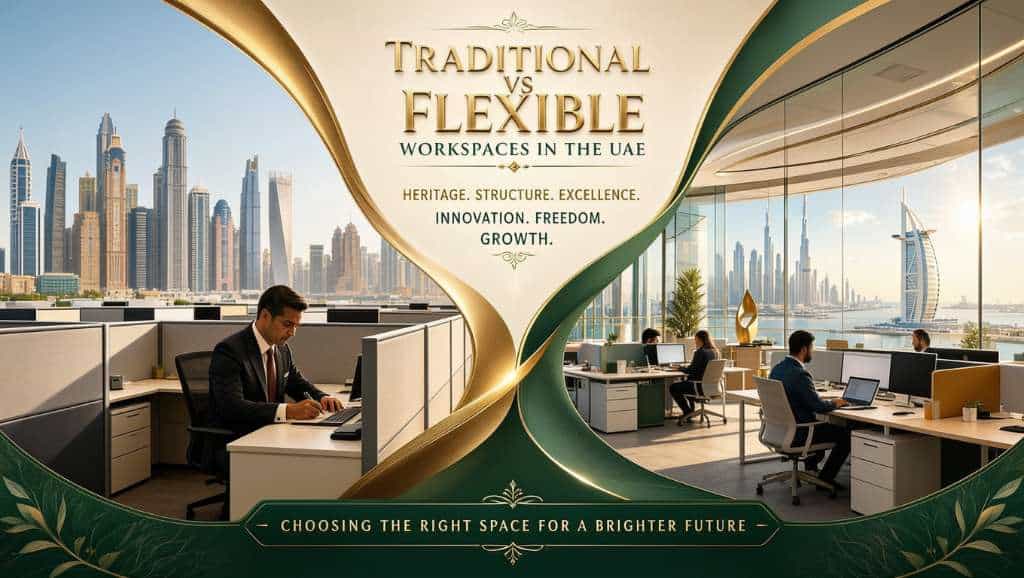
For decades, signing a commercial real estate lease in the UAE followed a rigid, predictable script: find a bare shell or semi-fitted space, commit to a minimum of three years, pay a massive security deposit, spend hundreds of thousands of dirhams on fit-outs, and pray your headcount projections were accurate.
Today, that script is being rewritten.
In a post-pandemic world defined by hybrid work, rapid market shifts, and a relentless focus on cash flow, business owners and founders are increasingly rejecting the traditional 3-to-5-year commercial lease. The anxiety of paying for empty desks and underutilized square footage has become a massive drain on company resources.
Enter the flexible workspace. What began as a niche solution for freelancers has evolved into a sophisticated, multi-billion-dirham industry catering to startups, SMEs, and even multinational corporations. Here is a detailed, data-backed look at why the traditional office lease is dying, and why flexible workspaces are becoming the default choice for UAE businesses.
The “Empty Desk” Dilemma
Imagine you are the founder of a growing tech startup in Dubai. You project hiring 15 new employees over the next 18 months. To accommodate them, you sign a traditional 3-year lease for a 2,000 sq. ft. office.
Six months in, imagine a market downturn hits, you have to freeze hiring, and two existng employees resign. Suddenly, you are paying premium rent, service charges, and utility bills for a space that is 30% empty. You are locked into the contract, and breaking the lease will trigger severe financial penalties.
This is the “empty desk dilemma,” and it is a primary source of financial stress for SMEs. Flexible workspaces eliminate this risk entirely. They allow businesses to transition from owning a physical asset to subscribing to a service. You pay only for the desks or private offices you actively use, and you can scale up or down with 30 days’ notice.
The Data: Analytics Behind the UAE Flexible Workspace Boom
The shift away from traditional leases is not just anecdotal; it is backed by rigorous market analytics. The UAE flexible office space market is experiencing robust, sustained growth as businesses prioritize agility over long-term real estate commitments.
Based on comprehensive industry analysis, the market’s financial trajectory and operational segmentation reveal a clear shift in corporate behavior:
UAE Flexible Workspace Market Financial Projections (2025–2031)
| Metric | 2025 Baseline | 2026 Estimate | 2031 Forecast | Growth Indicator |
|---|---|---|---|---|
| Total Market Valuation | USD 1.12 Billion | USD 1.23 Billion | USD 2.01 Billion | 10.24% CAGR (2026–2031) |
Data Source: Mordor Intelligence Industry Analysis
Operational Segmentation of the UAE Flexible Office Sector
| Workspace Category | Key Market Insight (2025) | Primary User Demographic & Value Driver |
|---|---|---|
| Coworking Hubs | Captured 49.9% of the total market share. | Freelancers, remote professionals, and startups seeking low-commitment, community-driven environments. |
| Serviced & Managed Offices | Experiencing rapid adoption among scaling enterprises. | SMEs and corporate teams requiring private, fully-furnished spaces with enterprise-grade IT and administrative support. |
| Virtual Offices & On-Demand Spaces | Growing steadily as hybrid work models normalize. | Distributed teams and international firms needing a prestigious local business address without physical overhead. |
Data Source: Mordor Intelligence Industry Analysis
These figures demonstrate that flexible workspaces are no longer a fringe alternative. They are a core component of the UAE’s commercial real estate ecosystem, engineered to enhance cognitive performance, foster spontaneous collaboration, and provide immediate scalability without heavy capital expenditure (CapEx).
Leading Flexible Workspace Providers in the UAE
For business leaders ready to make the switch, the UAE boasts a mature and highly competitive ecosystem of flexible workspace providers. Global giants like WeWork and Regus (IWG) maintain an extensive presence across both emirates, with premium locations in key business districts such as Dubai’s DIFC, One Central, and Business Bay, as well as Abu Dhabi’s Hub71 and Al Maryah Island.
Alongside these international brands, regional and homegrown providers are carving out strong, specialized niches. For instance, Maktabi has gained significant traction as a premier, community-driven workspace with multiple vibrant locations across Dubai. Similarly, Nook offers highly designed, boutique flexible offices tailored specifically for small businesses and entrepreneurs in high-demand areas like Dubai Business Bay. This diverse landscape ensures that whether a company needs a single hot desk in a collaborative environment or a fully branded, private office in a premium tower, there is a verified, turnkey solution readily available.
Head-to-Head: Traditional Lease vs. Flexible Workspace
To understand the financial and oprational impact of this shift, consider the direct comparison between the two models:
| Feature | Traditional 3-Year Commercial Lease | Flexible Workspace (Serviced Office / Coworking) |
|---|---|---|
| Commitment Term | 3 to 5 years (minimum) | 1 month to 1 year (highly flexible) |
| Upfront Capital (CapEx) | High (Agency fees, 5-10% security deposit, massive fit-out costs) | Near Zero (Usually just 1-2 months’ rent as a deposit) |
| Scalability | Very Low (Requires subleasing or breaking the lease to downsize) | Very High (Add or remove desks/offices with 30 days’ notice) |
| Maintenance & IT | Tenant’s responsibility (AC repairs, internet setup, cleaning) | Fully managed by the operator (All-inclusive monthly fee) |
| Amenities | Bare shell or basic; tenant must furnish and equip | Plug-and-play: High-speed Wi-Fi, meeting rooms, coffee, printing |
| Make-Good Clause | Yes (Tenant must restore space to original condition at exit) | No (You simply hand back the keys) |
| Ideal For | Large, stable corporations with predictable, long-term headcount | Startups, SMEs, hybrid teams, and companies testing new markets |
The Hidden Costs of the Traditional Lease
Many business owners are lured by a seemingly low “per square foot” rent in a traditional lease, only to be blindsided by the hidden costs that follow. A flexible workspace’s monthly fee is all-inclusive, whereas a traditional lease hides massive additional expenses:
- Fit-Out Costs: In the UAE, fitting out a bare-shell office can cost anywhere from AED 300 to AED 800+ per square foot, depending on the finish. For a 2,000 sq. ft. office, that is an upfront cash outlay of AED 600,000 to AED 1.6 million before a single employee sits down.
- Agency and Legal Fees: Typically 5% of the total contract value, plus legal drafting fees.
- Utility and Security Deposits: DEWA, Empower/Tabreed (chiller), and landlord security deposits can tie up tens of thousands of dirhams in non-performing capital.
- The “Make-Good” Penalty: At the end of a traditional lease, tenants are often contractually obligated to strip the office back to its original “bare shell” condition, incurring thousands in demolition and disposal fees.
Flexible workspaces absorb all of these costs into a single, predictable, tax-deductible monthly operational expense (OpEx).
How to Choose the Right Flexible Workspace
Not all flexible workspaces are created equal. As the market matures, quality varies significantly. When evaluating a provider, business leaders should assess:
- IT and Security Infrastructure: Does the provider offer enterprise-grade, redundant internet connections and secure, private phone booths for confidential calls?
- Location and Accessibility: Is the building close to major metro stations or highways? Is there adequate, affordable parking for staff and clients?
- Community and Networking: The best flexible workspaces curate their tenant mix, offering networking events, member apps, and B2B introductions that add tangible value beyond the physical desk.
- Contract Transparency: Ensure there are no hidden fees for meeting room usage, printing, or after-hours access. Read the fine print regarding notice periods for scaling down.
The Bottom Line
The traditional 3-year office lease is not disappearing overnight, but its dominance is undeniably waning. In an economic environment that rewards agility, penalizes bloated overhead, and prioritizes employee well-being, the rigid traditional lease is a liability.
Flexible workspaces have graduated from being a “trend” to becoming a core strategic tool for UAE businesses. They offer the ultimate competitive advantage: the freedom to focus on growing your business, rather than managing your real estate.
Sources & Further Reading
- Mordor Intelligence. UAE Flexible Office Space Market Size & Share Analysis. Comprehensive industry report detailing the market valuation of USD 1.12 billion in 2025, the projected growth to USD 1.23 billion in 2026 and USD 2.01 billion by 2031 (at a 10.24% CAGR), and the 49.9% market share captured by coworking models.
https://www.mordorintelligence.com/industry-reports/uae-flexible-office-space-market - Devx Work. Top Coworking Spaces in Dubai for Small Businesses. Verified market analysis identifying boutique providers like Nook Coworking Space as top-tier flexible office solutions in high-demand areas such as Dubai Business Bay.
https://www.devx.work/blog/top-coworking-spaces-in-dubai - CloudSpaces. Coworking Space Trends 2026 for UAE. Analysis of how UAE businesses are moving beyond basic flexible layouts to seek environments specifically engineered to enhance cognitive performance, collaboration, and operational scalability.
https://www.cloudspaces.ae/post/coworking-in-2026-what-uae-businesses-should-expect-from-the-future-of-work
Disclaimer: This article is for informational purposes only and does not constitute legal, financial, or commercial real estate advice. Lease terms, fit-out costs, and market conditions are subject to change. Always consult with a qualified commercial real estate advisor and legal counsel before signing any commercial tenancy agreement in the UAE.