For e-commerce founders, import-export managers, and logistics operators in the UAE, one of the most critical and stressful decisions is where to base their warehousing operations.
The dilemma is universal: Do you lease cheaper, tax-advantaged warehouse space in a Free Zone, knowing you will face regulatory hurdles and customs duties when delivering to mainland customers? Or do you pay a premium for Mainland warehouse space to enjoy unrestricted, direct access to the entire UAE consumer market?
There is no one-size-fits-all answer. The right choice depends entirely on your business model, target audience, and cash flow. This guide breaks down the legal, financial, and operational realities of both options using verified 2025/2026 market data, ensuring you can make a decision based on facts, not guesswork.
The Financial Reality: Setup Costs and Lease Rates
The most immediate difference between Mainland and Free Zone warehousing lies in the upfront capital expenditure (CapEx) and ongoing operational expenditure (OpEx).
While Free Zones are renowned for streamlined, cost-effective business setup, Mainland operations often involve higher administrative friction, including mandatory physcal space requirements and longer licensing lead times
However, the actual cost of leasing the warehouse itself can vary dramatically based on location and grade.
Table 1: Estimated Warehouse Lease Rates & Setup Costs (2025/2026)
| Cost Factor | Mainland Warehouse (e.g., Dubai Industrial City, Al Quoz) | Free Zone Warehouse (e.g., JAFZA, DAFZA, KEZAD) |
| Basic License Setup Cost | Starts around AED 15,000 – 20,000+, but scales with activity and mandatory physical space requirements | Highly standardized, often lower upfront, with flexible options ranging from shared storage to dedicated units |
| Grade A Lease Rates (Annual) | Averages AED 28 – 32 per sq. ft. in areas like Dubai Industrial City and Investment Park | Averages AED 350 – 400+ per sq. ft. in premium zones like JAFZA, with top-tier spaces reaching AED 434 per sq. ft. |
| Example Annual Rent | A 50,000 sq. ft. facility in Dubai Industrial City: ~AED 1,400,000/year. | A standard 67,000 sq. ft. facility in JAFZA: ~AED 3,082,000/year |
| Market Trend | Dubai’s overall warehousing and industrial rental rates have increased by 13% year-on-year due to surging e-commerce demand | Abu Dhabi’s KEZAD is actively expanding, adding 250,000 sqm of warehouse capacity by 2025 to meet growing logistics needs |
Note: Lease rates are subject to market fluctuations. The stark difference in per-square-foot pricing between Mainland industrial cities and premium Free Zones like JAFZA reflects the premum placed on Free Zone customs advantages and port proximity.
The Customs Conundrum: Understanding the 5% Duty Trigger
The most misunderstood aspect of UAE logistics is how customs duties apply to Free Zone warehouses. Many entrepreneurs assume a Free Zone license means “zero tax” on all goods. This is only partially true.
Customs & VAT Implications: Free Zone vs. Mainland
| Scenario | Mainland Warehouse | Free Zone Warehouse |
| Importing Goods into the UAE | Standard 5% customs duty and 5% VAT are payable immediately upon clearance through UAE | 0% customs duty and deferred VAT as long as the goods remain physically within the Free Zone |
| Selling to Mainland Customers | No additional customs duties. Goods can be dispatched directly to consumers or retailers across the UAE | The moment goods leave the Free Zone to enter the mainland market, they are treated as a formal import. The standard 5% customs duty and 5% VAT become immediately payable |
| Re-exporting Goods | Requires complex customs drawback procedures to reclaim duties paid on imports. | Highly efficient. Goods can be re-exported globally without ever incurring UAE customs duties |
The Operational Impact: If your business model involves importing bulk goods, storing them, and then distributing them in small batches to mainland retailers or individual consumers, a Free Zone warehouse means you will pay customs clearance and duties on every single outbound shipment to the mainland. This can quickly erase the initial savings of a cheaper setup.
Operational Realities: Market Access and Logistics
Beyond finances and taxes, the day-to-day operational realities of Mainland versus Free Zone warehousing are vastly different.
1. Unrestricted Market Access (Mainland Advantage)
Mainland companies deliver unmatched market access and operational flexibility
A Mainland-licensed business can trade directly with any customer, retailer, or distributor anywhere in the UAE, including other Free Zones, without requiring a third-party intermediary. For last-mile e-commerce delivery, this direct access is invaluable.
2. The Local Distributor Requirement (Free Zone Restriction)
While Free Zone companies excel in international trade and re-export, their direct access to the mainland consumer market is legally restricted
To sell physical goods directly to mainland customers, a Free Zone company typically must either:
- Appoint a local Mainland distributor to handle the final sale and delivery.
- Go through a formal customs clearance process for every individual mainland shipment, acting as the importer of record each time
3. Physical Space and Compliance
Mainland regulations generally mandate a physical office or warehouse space tied to your trade license, which can increase combined setup costs
Free Zones, conversely, often provide highly flexible options, including flexi-desks, shared workspaces, or modular storage units, allowing businesses to scale their physical footprint incrementally
Top UAE Logistics & Warehousing Hubs at a Glance
Not all zones are created equal. Your choice of location should align with your specific supply chain needs (e.g., sea freight, air freight, or road distribution).
Table 3: Top UAE Logistics Hubs Compared
| Hub / Zone | Emirate | Best Suited For | Key Advantage |
| Jebel Ali Free Zone (JAFZA) | Dubai | Large-scale import/export, sea freight, heavy machinery. | Direct adjacency to Jebel Ali Port (largest in the region) and world-class Grade A logistics |
| Dubai Airport Free Zone (DAFZA) | Dubai | High-value, low-volume goods, pharmaceuticals, electronics. | Unbeatable proximity to Dubai International Airport (DXB) for rapid air freight clearance |
| KEZAD (Khalifa Economic Zones) | Abu Dhabi | Manufacturing, heavy industry, and cost-effective bulk storage. | Massive scale, integrated with Khalifa Port, and actively expanding capacity by 43% through 2025. |
| Dubai Industrial City (DIC) | Dubai (Mainland) | E-commerce fulfillment, mainland distribution, light manufacturing. | Strategic mainland location with lower lease rates (avg. AED 28/sq. ft.) and direct highway access to all seven emirates. |
The Verdict: How to Choose
The decision between Mainland and Free Zone warehousing boils down to your primary revenue stream.
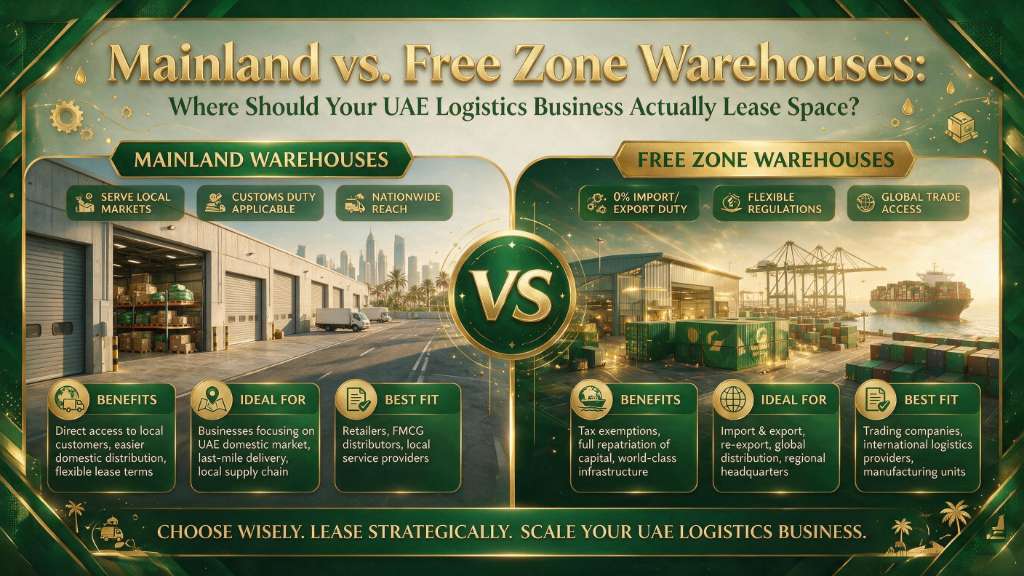
Choose a Free Zone Warehouse If:
- Your primary business is re-exporting goods to markets outside the UAE.
- You import bulk materials for manufacturing or assembly within the Free Zone before exporting the finished product.
- You are a B2B supplier selling exclusively to other Free Zone companies.
- You want to defer customs duties and VAT for as long as possible to optimize cash flow
Choose a Mainland Warehouse If:
- Your primary target market is UAE mainland consumers or retailers (e.g., Amazon.ae sellers, local retail distribution).
- You want to avoid the administrative burden and 5% customs duty hit on every individual mainland delivery.
- You require the flexibility to bid on government tenders or corporate contracts that mandate a Mainland trade license.
- You prioritize lower per-square-foot lease rates in dedicated industral cities over the premium branding of a Free Zone.
The Bottom Line
There is no universally “better” option, only the option that is better for your specific supply chain. A low setup cost in a Free Zone might conceal higher operational expenses in the form of repeated customs duties, while a Mainland warehouse’s higher baseline rent might be offset by seamless, duty-free mainland distribution.
Before signing a lease, map out your exact customer locations, calculate the landed cost of your goods including the 5% duty trigger, and consult with a licensed UAE business setup advisor to ensure your logistics strategy is both legally compliant and financially optimized.
Sources & Further Reading
- Global Law Experts. Free Zone Vs Mainland UAE 2026. Detailed legal analysis of the administrative friction, physical space mandates, and licensing lead times associated with Mainland setups.
https://globallawexperts.com/free-zone-vs-mainland-uae-2026/ - 3s Business. Freezone vs Mainland: Which is Better for Your Business in 2026? Breakdown of baseline setup costs, noting Mainland licenses starting around AED 15,000–20,000 before additional operational costs.
https://3sbusinessme.com/blogs/freezone-vs-mainland-uae-business-2026/ - Knight Frank. Dubai and Abu Dhabi Industrial Markets Review. Authoritative real estate data detailing lease rates per square foot in Dubai Industrial City (AED 28 psf) and Investment Park (AED 32 psf).
https://content.knightfrank.com/research/2451/documents/en/dubai-and-abu-dhabi-industrial-markets-review-2022-2023-9848.pdf - Cushman & Wakefield. Warehouse Rents Up 13% as Industrial Sector Demand Leaps. Market analysis confirming the 13% year-on-year increase in Dubai’s warehousing and industrial rental rates due to strong e-commerce demand.
https://www.cushwake.ae/news/warehouse-rents-up-13-as-industrial-sector-demand-leaps-most-sought-after-sectors-revealed - Uni Garden Group. Free Zone vs Mainland UAE 2025: Which is Better for Import/Export? Strategic overview confirming 0% customs duty within the Free Zone, but the inability to trade directly with the mainland without a local distributor or formal customs clearance.
https://unigardengroup.com/blogs/free-zone-vs-mainland-uae-2025-which-is-better-for-import-export-businesses/
Disclaimer: This article is for informational purposes only and does not constitute legal, financial, or commercial real estate advice. Customs regulations, lease rates, and licensing requirements are subject to change by UAE authorities. Always consult with a licensed business setup advisor and customs clearing agent before finalizing your logistics strategy.